Important:
Compliance Rules act as an additional set of Rules that will always override any non-Compliance Rules (Standard Rules). Compliance Rules have the same syntax and features as the Standard Rule type. The Compliance Rules allow requirements from different stakeholders to be managed independently. Example: Project managers in IT manage standard Rules and typically legal staff manage Compliance Rules.
Examples of Compliance Rules include:
- Rules with restrictions to comply with country-specific laws. Example: Disable Voice-over-IP for all users in <country>.
- Rules with restrictions to comply with organizational policies. Example: Disable Archiving of Instant Messages for the HR department.
- Rules with restrictions to comply with legal requirements. Example: Archiving of Instant Messages enabled for the financial trading department.
Important:
Compliance Rules will always override the Standard Rules.
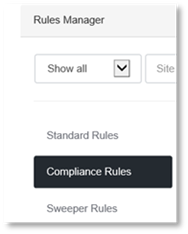
To work with Compliance Rules, select Compliance Rules in the Rules Manager home page.